Journal of Analytical & Bioanalytical Techniques
Open Access
Our Group organises 3000+ Global Events every year across USA, Europe & Asia with support from 1000 more scientific Societies and Publishes 700+ Open Access Journals which contains over 50000 eminent personalities, reputed scientists as editorial board members.
Open Access Journals gaining more Readers and Citations
700 Journals and 15,000,000 Readers Each Journal is getting 25,000+ Readers
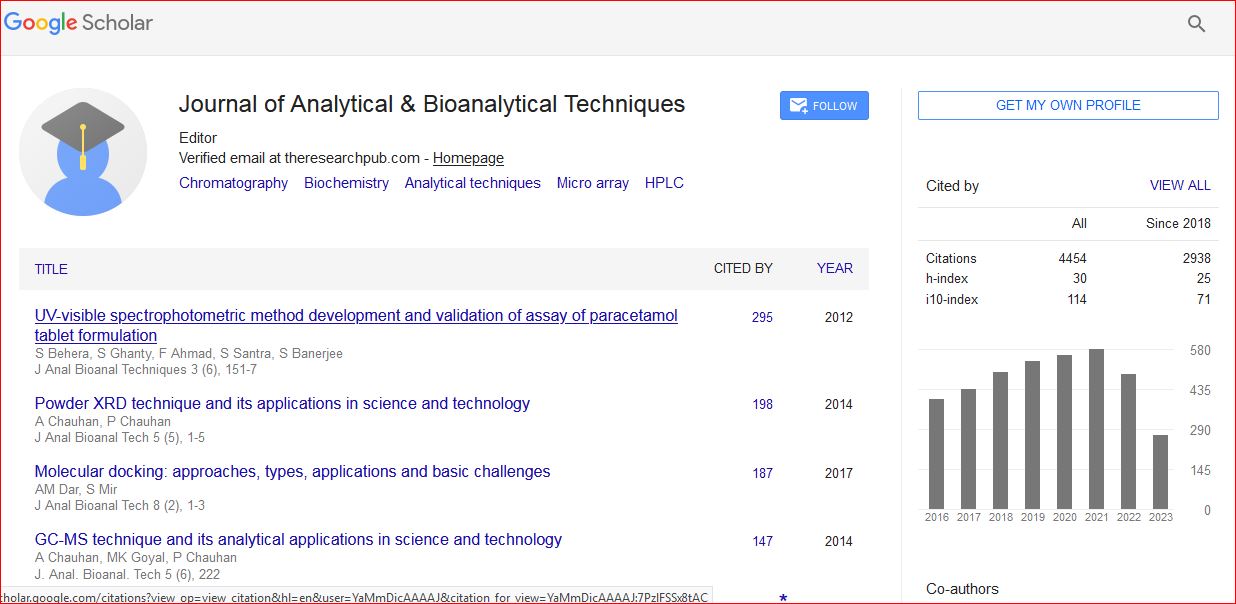
Citations : 6413
Indexed In
- CAS Source Index (CASSI)
- Index Copernicus
- Google Scholar
- Sherpa Romeo
- Academic Journals Database
- Open J Gate
- Genamics JournalSeek
- JournalTOCs
- ResearchBible
- China National Knowledge Infrastructure (CNKI)
- Ulrich's Periodicals Directory
- Electronic Journals Library
- RefSeek
- Directory of Research Journal Indexing (DRJI)
- Hamdard University
- EBSCO A-Z
- OCLC- WorldCat
- Scholarsteer
- SWB online catalog
- Virtual Library of Biology (vifabio)
- Publons
- Euro Pub
- ICMJE
Useful Links
Related Subjects
Share This Page
A new analytical procedure to determine the bioactive compounds profile of olive polyphenols
6th International Conference and Exhibition on Analytical & Bioanalytical Techniques
Abdelhakim Bakhouche1, 2, Jes�?潞s Lozano-S�?隆nchez2, 3, Cristiano Augusto Ballus4, Alessandra Bendini5, Tullia Gallina-Toschi5, Alberto Fern�?隆ndez-Guti�?漏rrez1, 2 and Antonio Segura-Carretero1, 2
1University of Granada, Spain 2Health Science Technological Park, Spain 3Research and Development of Functional Olive Oil Department, Spain 4University of Campinas (UNICAMP), Brazil 5University of Bologna, Italy
Posters-Accepted Abstracts: J Anal Bioanal Tech
DOI:
Abstract
The aim of this study was the establishment of a new analytical procedure, to correct the effect that moisture reduction after virgin olive oil (VOO) filtration exerts on the apparent increase of secoiridoids, using internal standard during extraction. To achieve this purpose, a mixture of VOOs from Picual and Hojiblanca varieties were filtered at industrial scale. A total of 24 samples of filtered and unfiltered VOOs samples were recovered, and moisture content was determined in each of them. Different internal standards (luteolin 7-glucoside, dihydrocaffeic acid, taxifolin, and oleuropein) were tested during Liquid-Liquid extraction step of phenolic compounds from VOOs samples. Afterwards, the obtained extracts were analyzed using high performance liquid chromatography coupled to electrospray time-of-flight mass spectrometry. The results clearly showed that filtration sharply decreased moisture, phenolic alcohols, and flavons. Among the internal standards tested, oleuropein was chosen and, for the first time, the apparent increase of secoiridoids in filtered VOO was corrected, using a correction coefficient (Cc) calculated from the variation of internal standard area in filtered and unfiltered VOO during extraction. This approach gave the real concentration of secoiridoids in filtered VOO, and clarified the effect of the filtration step on the phenolic fraction. The analytical procedure established in this study can be applied in all studies aiming the quantification of phenolic compounds in VOO.Biography
Email: abdelhakim@ugr.es
