
Journal of Obesity & Weight Loss Therapy
Open Access
Our Group organises 3000+ Global Events every year across USA, Europe & Asia with support from 1000 more scientific Societies and Publishes 700+ Open Access Journals which contains over 50000 eminent personalities, reputed scientists as editorial board members.
Open Access Journals gaining more Readers and Citations
700 Journals and 15,000,000 Readers Each Journal is getting 25,000+ Readers
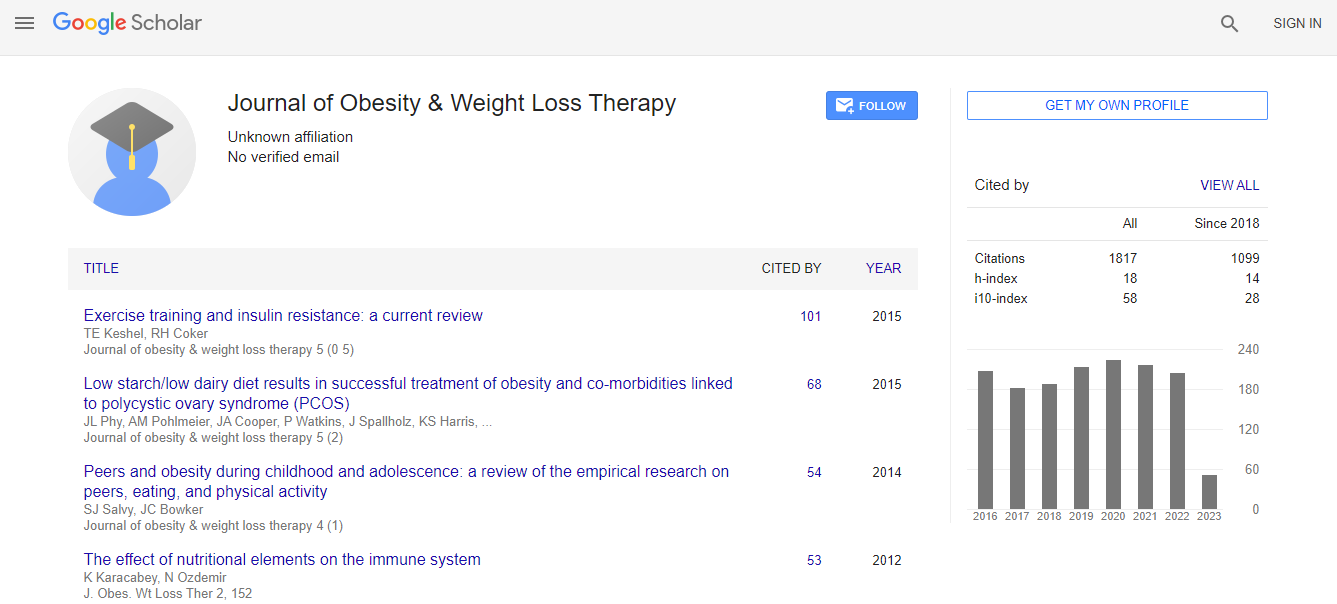
Citations : 2305
Indexed In
- Index Copernicus
- Google Scholar
- Open J Gate
- Genamics JournalSeek
- Centre for Agriculture and Biosciences International (CABI)
- RefSeek
- Hamdard University
- EBSCO A-Z
- OCLC- WorldCat
- SWB online catalog
- CABI full text
- Cab direct
- Publons
- Geneva Foundation for Medical Education and Research
- Euro Pub
- University of Bristol
- Pubmed
- ICMJE
Useful Links
Recommended Journals
Related Subjects
Share This Page
Chubby child is a cute child or not!
Middle East Obesity, Bariatric Surgery and Endocrinology Congress
Mohamad Miqdady
Sheikh Khalifa Medical City, UAE
Keynote: J Obes Weight Loss Ther
DOI:
Abstract
Obesity epidemic is a very serious concern for the medical professionals as well as the community. It is estimated that 30-35 % of children in US are overweight or obese, and probably higher percentages apply in our community. Local data will be presented. Overweight is defined as a BMI of >85% and obesity if BMI >95%. BMI correlates very well with comorbidities. Obesity occurs when there is imbalance between energy intake and energy output. There is a universal trend towards decreasing physical activity and increasing dietary intake among adults and children. Unlike the animal model, most obese humans are leptin resistant rather than deficient. Childhood obesity is clearly associated with adulthood obesity with the strongest association if obesity occurs at later childhood. Obese children are usually taller with advanced bone age and enter puberty earlier. Comorbidities are many and involve almost all body systems: (1) CVS: Hypertension, coronary artery disease, pulmonary hypertension cor pulmonale, cardiomyopathy and atherosclerosis. (2) Pulmonary: Obstructive sleep apnea and Pickwickian syndrome. (3) Gastrointestinal: Gallbladder diseases, nonalcoholic steatohepatitis and reflux. (4) CNS: Stroke and increased intracranial pressure. (5) Orthopedic: Osteoarthritis, slipped capital femoral epiphyses, low back pain and Legg-Calv�?漏-Perthes disease. (6) Psychological: Social stigmatization, depression and lack of self-esteem. (7) Endocrine: Early puberty, hyperandrogenism, anovulation, infertility, polycystic ovaries and hypogonadotrophic hypogonadism. (8) Malignancy: Increased risk of malignancy: Endometrial cancer, prostate cancer, gall bladder cancer, breast cancer and colon cancer. (9) Metabolic: Insulin resistance, type-2 DM, dyslipidemia (茂�?隆cholesterol, 茂�?隆TG, 茂�?隆LDL, 茂�?垄HDL). Although genetic and hormonal causes are rare causes of obesity; they should always be kept in mind. Managing obese individuals is challenging and with limited success. Management should include exercise, diet and behavioral modification. Exercise should be 30-60 minutes 5-7 days a week. Normal or low calorie diets with the appropriate use of the food pyramid are to be used in most individuals. Medications and surgery can be included in certain indications in conjunction with diet and exercise.Biography
Mohamad Miqdady is American board certified in Pediatric Gastroenterology, Hepatology and Nutrition. He is the Division Chief, Pediatric Gastroenterology, Hepatology and Nutrition Division at Sheikh Khalifa Medical City in UAE. He is also an Adjunct Staff at Cleveland Clinic, Ohio, USA, Member of the FISPGHAN Council (Federation of International Societies of Pediatric Gastroenterology Hepatology and Nutrition) and Expert Member of FISPGHAN Malnutrition/Obesity Expert team. He has completed his Fellowship in Pediatric Gastroenterology at Baylor College of Medicine and Texas Children’s Hospital in Houston, USA. He held the position of Assistant Professor at Jordan University of Science and Technology in Jordan for six years prior to joining SKMC. His main research interests include feeding difficulties, picky eating, obesity, procedural sedation, allergic GI disorders and celiac disease. He has several publications and authored few book chapters. He is on the Editorial Board of few journals including Gastroenterology & Hepatology.
E-mail: msmiqdady@yahoo.com
