Journal of Palliative Care & Medicine
Open Access
Our Group organises 3000+ Global Events every year across USA, Europe & Asia with support from 1000 more scientific Societies and Publishes 700+ Open Access Journals which contains over 50000 eminent personalities, reputed scientists as editorial board members.
Open Access Journals gaining more Readers and Citations
700 Journals and 15,000,000 Readers Each Journal is getting 25,000+ Readers
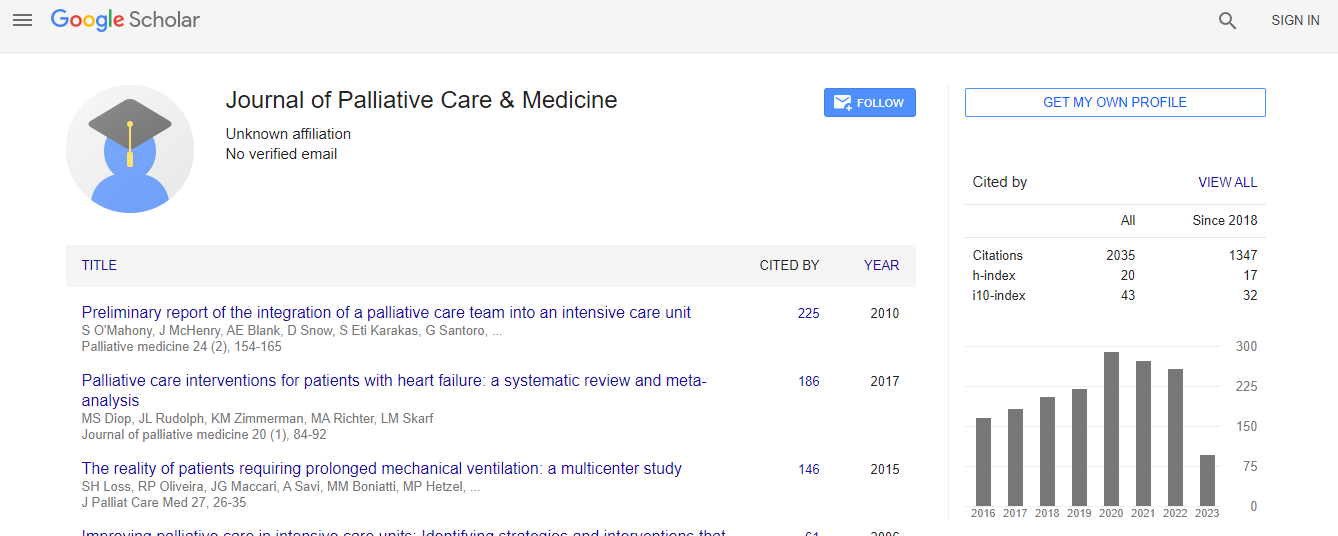
Citations : 1689
Indexed In
- Index Copernicus
- Google Scholar
- Open J Gate
- Genamics JournalSeek
- China National Knowledge Infrastructure (CNKI)
- Electronic Journals Library
- RefSeek
- Hamdard University
- EBSCO A-Z
- OCLC- WorldCat
- Virtual Library of Biology (vifabio)
- Publons
- Geneva Foundation for Medical Education and Research
- Euro Pub
- ICMJE
Useful Links
Recommended Journals
Related Subjects
Share This Page
COMPASSION FATIGUE AND COMPASSION SATISFACTION AMONG INFORMAL CAREGIVERS OF OLDER ADULTS, IN ARAB ISRAELI
7th International Conference on Geriatrics Gerontology & Palliative Nursing
Rabia Khalaila
Zefat Academic College, Israel
ScientificTracks Abstracts: J Palliat Care Med
DOI:
Abstract
There is extensive professional literature on compassion fatigue among professional caregivers, yet very few studies of the phenomenon among informal family caregivers of an elderly relative. The aims were to examine the association between caregiving burden and compassion fatigue (burnout, secondary traumatization), and compassion satisfaction among informal caregivers; and to examine models of mediation (social support and coping style) and moderating effect (emotional empathy) in these associations. Cross-sectional study studied 300 informal caregivers of an elderly parent from the Arab community in Israel. Data gathering was accomplished through face-to-face interviews in Arabic using structured questionnaires. Linear regression analyses were applied to the hypotheses using bootstrapping models. The results showed about 20%-45% of the caregivers suffer from various symptoms of compassion fatigue. A positive correlation was found between caregiving burden and burnout and secondary traumatization. These associations were found to be partially mediated by disengagement coping and perceived social support. A negative correlation was found between the burden and compassion satisfaction of the care. This association was found to be partially mediated by disengagement coping. Findings showed that emotional empathy moderates the association between caregiving burden and burnout. The study suggests that compassion fatigue exists among informal caregivers in the Arab community in Israel. The current study shows that compassion fatigue may be reduced by lessening the burden of care, reinforcing social support, and reducing the use of disengagement coping. Decreased emotional empathy by the caregiver is likely to be protection against the harmful effects of caregiving burden on burnout.Biography
Rabia Khalaila worked for 10 years at Hadassah Hospital as a staff nurse, and he was promoted in the last 5 years to be a head nurse in the intensive care unit. In 2009 he moved to work in the Zefat Academic College. Rabia is the head of the Department of Nursing in Zefat College. His research interests include nursing, social gerontology and nursing education. He published 24 written works mostly in peer review journals and another four papers are in preparation or under review process.
