
ISSN:2167-7964
Journal of Radiology
Open Access
Our Group organises 3000+ Global Events every year across USA, Europe & Asia with support from 1000 more scientific Societies and Publishes 700+ Open Access Journals which contains over 50000 eminent personalities, reputed scientists as editorial board members.
Open Access Journals gaining more Readers and Citations
700 Journals and 15,000,000 Readers Each Journal is getting 25,000+ Readers
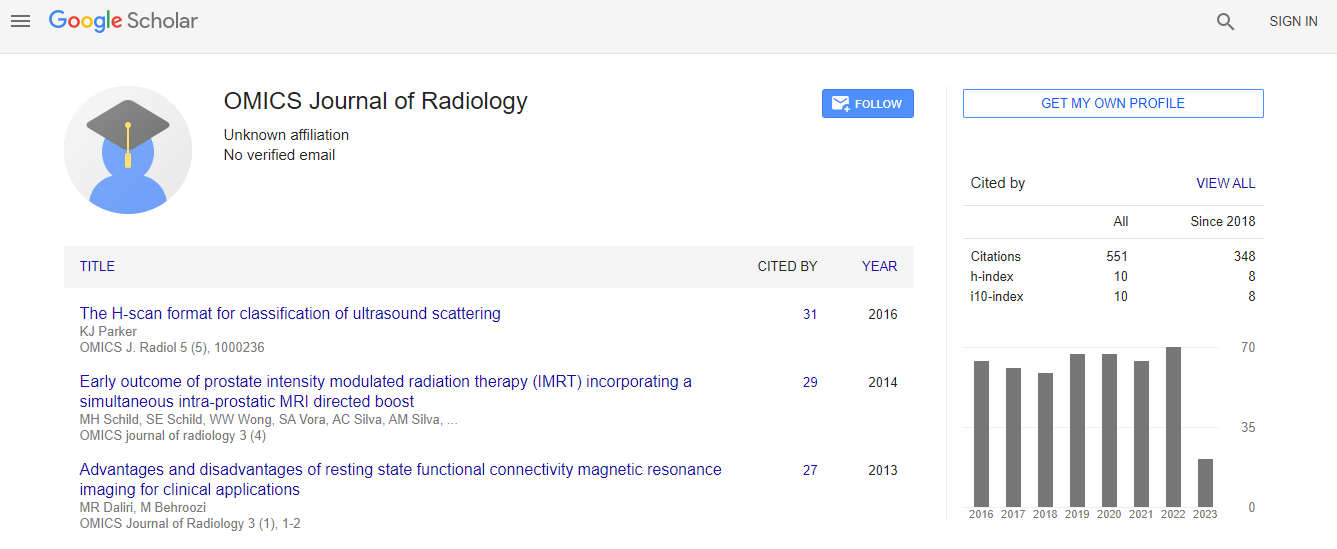
Citations : 551
Indexed In
- Index Copernicus
- Google Scholar
- Open J Gate
- Genamics JournalSeek
- ResearchBible
- Electronic Journals Library
- RefSeek
- Hamdard University
- EBSCO A-Z
- OCLC- WorldCat
- SWB online catalog
- Virtual Library of Biology (vifabio)
- Publons
- Geneva Foundation for Medical Education and Research
- ICMJE
Useful Links
Share This Page
Decision-making of cancer patients about end-of-life: The lived experience
2nd World Congress on Radiology and Oncology
Angela Katrina G Fonte
Far Eastern University, Philippines
Posters & Accepted Abstracts: 中国P站 J Radiol
DOI:
Abstract
Understanding the perception of an end-stage cancer patient about end-of-life decision making can help the patient鈥檚 relatives, healthcare providers and the person himself or herself in attaining the best quality of life in their exit event. The aim of this study is to deeply gain an understanding of the voice and feelings of stage 4 cancer patients in making decisions for end-of-life. The study was conducted using a qualitative phenomenological approach. Five participants who are of sound mind and able to make rational decisions shared their preferences. The participants were selected using a non-probability, criterion, purposive sampling. Data were gathered through the use of a semi-structured interview. Four major themes emerged from the analysis of the data. The themes were leaving protracted misery, divesting the burden, feeling of complacency and living in a former time. These themes encircles mainly on the issue of cycle of suffering and prolonging one鈥檚 agony with the use of life-saving measures which can reduce the quality of life. Findings of the study revealed that end-of-life decision making is encapsulated with different factors which include physical discomfort and exhaustion, emotional distress, spiritual dilemma and financial burden. Recommendations include educational training for nurses about end-of-life care and discussion of ethical issues, culturally competent care and management of patients who are facing end-of-life decision making. It is also recommended that physicians should take the lead and explore the end-of-life preferences of patients and their families.Biography
E-mail: katrinafonte@yahoo.com.ph
