ISSN: 2155-952X
Journal of Biotechnology & Biomaterials
Open Access
Our Group organises 3000+ Global Events every year across USA, Europe & Asia with support from 1000 more scientific Societies and Publishes 700+ Open Access Journals which contains over 50000 eminent personalities, reputed scientists as editorial board members.
Open Access Journals gaining more Readers and Citations
700 Journals and 15,000,000 Readers Each Journal is getting 25,000+ Readers
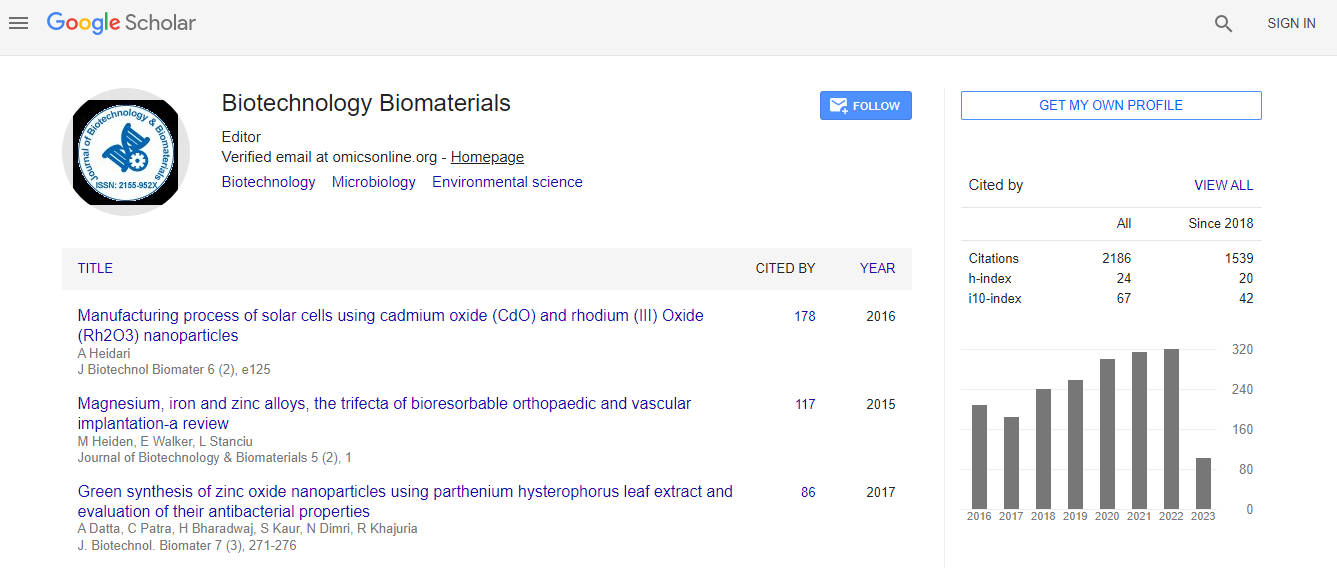
Citations : 3330
Indexed In
- Index Copernicus
- Google Scholar
- Sherpa Romeo
- Open J Gate
- Genamics JournalSeek
- Academic Keys
- ResearchBible
- China National Knowledge Infrastructure (CNKI)
- Access to Global Online Research in Agriculture (AGORA)
- Electronic Journals Library
- RefSeek
- Hamdard University
- EBSCO A-Z
- OCLC- WorldCat
- SWB online catalog
- Virtual Library of Biology (vifabio)
- Publons
- Geneva Foundation for Medical Education and Research
- Euro Pub
- ICMJE
Useful Links
Recommended Journals
Related Subjects
Share This Page
In Association with
Determination of minimum inhibitory concentration of Chrysobacterium indolegenes HMT 47 isolated from Zawar mines, Udaipur, Rajasthan, India
6th World Congress on Biotechnology
Harshada Joshi
Mohanlal Sukhadia University, India
Posters-Accepted Abstracts: J Biotechnol Biomater
DOI:
Abstract
Heavy metal pollution is an environmental problem of worldwide concern because most of them can be toxic even at low concentrations. Industrialized societies are responsible for increasing environmental contamination by trace metals produced as wastes from industrial and agricultural processes and household activities. In the present study isolation, identification and determination of the minimum inhibitory concentration (MIC) of Chrysobacterium indolegenes HMT 47 was done. The strain was isolated from rhizospheric soil of plants growing in mine spoil of Zawar mines, Udaipur, Rajasthan, India. Isolation was done on nutrient agar supplementated with 0.5 mM of Lead Nitrate by standard Pour Plate Method. The isolate was then identified on the basis of morphological and biochemical characteristics which was further confirmed by 16S rRNA gene sequencing. The amplification reaction was proformed using 16S rRNA gene specific universal primers namely 27F and 1492R. The minimum inhibitory concentration of Chrysobacterium indolegenes HMT 47 against lead was determined on nutrient agar supplementated with varying concentrations of lead nitrate ranging from 100 to 1100 �?录g/ml. The MIC of the isolate against lead nitrate was found to be 1000 �?录g/ml. The lead tolerant bacterium can proved to be a potential bioremediation tool for in situ stabilization and remediation of Lead contamination sites.Biography
Email: hjbiotech@gmail.com
