
ISSN:2167-7964
Journal of Radiology
Open Access
Our Group organises 3000+ Global Events every year across USA, Europe & Asia with support from 1000 more scientific Societies and Publishes 700+ Open Access Journals which contains over 50000 eminent personalities, reputed scientists as editorial board members.
Open Access Journals gaining more Readers and Citations
700 Journals and 15,000,000 Readers Each Journal is getting 25,000+ Readers
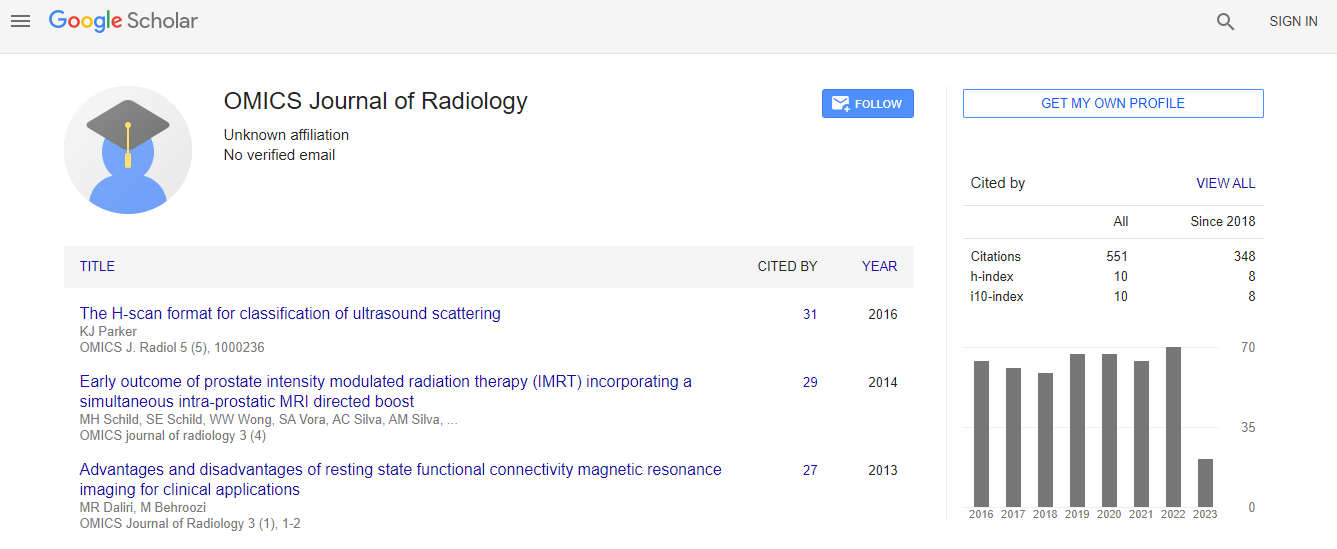
Citations : 551
Indexed In
- Index Copernicus
- Google Scholar
- Open J Gate
- Genamics JournalSeek
- ResearchBible
- Electronic Journals Library
- RefSeek
- Hamdard University
- EBSCO A-Z
- OCLC- WorldCat
- SWB online catalog
- Virtual Library of Biology (vifabio)
- Publons
- Geneva Foundation for Medical Education and Research
- ICMJE
Useful Links
Share This Page
Interventional hemodynamic managements of hepatic encephalopathy associated with portosystemic shuntsb
2nd World Congress on Radiology and Oncology
Bhatnagar Shorav and Sharma Gagan
QRG Central Hospital & Research Centre, India
Posters & Accepted Abstracts: 中国P站 J Radiol
DOI:
Abstract
Objective: To describe various techniques for reduction/occlusion of the blood flow in gastro-renal/leino renal shunts for controlling the arterial ammonia level causing hepatic encephalopathy and suggesting the best technique according to individual patient needs. Method: In 11 patients, different technique of blood flow reduction in shunt was used according to size, shape and position and origin of the shunt. Out of 11 patients, 8 underwent for shunt obliteration, 2 underwent for splenic artery embolization and 1 underwent for leino renal shunt reduction. For leino renal shunt reduction, a stent (preformed hour glass shape) was deployed in shunt and multiple coils of varying sizes were deployed in the space between stent and shunt wall. For obliteration of shunts, catheter was positioned deep inside the varix and after inflating the balloon sclerosing agent in the form of foam was infused with the goal of filling the full extent of varices. For reduction of flow in shunt, polyvinyl alcohol particles were infused in lower pole branches of spleen. It causes decrease blood in splenic vein. Result: 7/8 shunt obliteration, 1/1 shunt reduction and 2/2 partial splenic artery embolization showed significant reduction in arterial ammonia level. Conclusion: Ammonia level can be controlled by controlling blood flow through the shunts. Various interventional methods are available and must select according to the size, shape and position of shunt.Biography
E-mail: drshorav@yahoo.com
