
Journal of Bioremediation & Biodegradation
Open Access
Our Group organises 3000+ Global Events every year across USA, Europe & Asia with support from 1000 more scientific Societies and Publishes 700+ Open Access Journals which contains over 50000 eminent personalities, reputed scientists as editorial board members.
Open Access Journals gaining more Readers and Citations
700 Journals and 15,000,000 Readers Each Journal is getting 25,000+ Readers
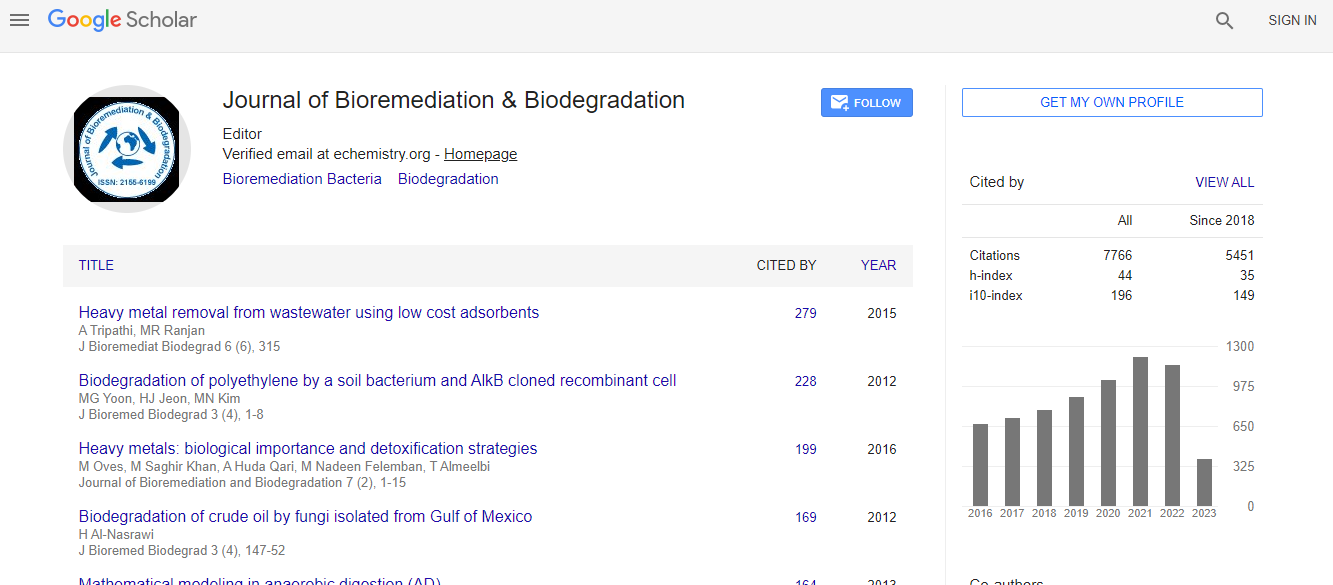
Citations : 7718
Indexed In
- CAS Source Index (CASSI)
- Index Copernicus
- Google Scholar
- Sherpa Romeo
- Open J Gate
- Genamics JournalSeek
- Academic Keys
- JournalTOCs
- ResearchBible
- China National Knowledge Infrastructure (CNKI)
- Ulrich's Periodicals Directory
- Access to Global Online Research in Agriculture (AGORA)
- RefSeek
- Hamdard University
- EBSCO A-Z
- OCLC- WorldCat
- SWB online catalog
- Publons
- Geneva Foundation for Medical Education and Research
- MIAR
- ICMJE
Useful Links
Recommended Journals
Related Subjects
Share This Page
In Association with
Novel bio-based elastomeric polymer based on semi-interpenetrating poly(3-hydroxyalkanoate)s and sunflower oil using a trithiol as crosslinking agent
International Conference on Sustainable Bioplastics
Carine Mangeon, France Thevenieau, Estelle Renard and Valerie Langlois
Universit�?漏 Paris Est, France Groupe Avril, Paris
ScientificTracks Abstracts: J Bioremediat Biodegrad
DOI:
Abstract
Poly(3-hydroxyalkanoate)s (PHAs), have been suggested as green substitutes to replace petroleum-based commodity polymer because of their biodegradability, biocompatibility and versatility. Although PHAs are very promising material in the field of eco-friendly plastics, their intrinsic brittleness and narrow processing temperature window limit their range of application. As a consequence, many attempts have been made to develop PHA with better mechanical and thermal properties. In recent years, much attention has been focused on the development of polymeric materials from vegetable oils, a sustainable resource. Their competitive cost, worldwide availability and built-in functionality (ester functions and in saturations) make them attractive to reinforce various types of polymers. In this study, we reported a unique approach to toughen PHAs by increasing their elongation at break and enhancing their thermal stability using sunflower oil (SO). The strategy consisted of synthesis of a bio-based semi-interpenetrating (semi-IPNs) network by crosslinking sunflower oil and trim�?漏thylolpropane tris(3-mercaptopropionate), a trithiol using 芒�?�?click芒�?聺 thiol-ene reactions into linear PHA polymer matrix. This functionalization process that is characterized by high yields, high reaction rate and short reaction time was initiated photochemically by ultraviolet light in the presence of a photoinitiator 2,2-dim�?漏thoxy-2-ph�?漏nylac�?漏toph�?漏none (DMPA). The resulting semi- IPNs PHA/SO exhibited excellent flexibility and showed relatively good thermal stability. Mechanical analysis results have shown that semi-IPNs with 30 wt% of cross-linked sunflower oil displayed excellent properties with an increase of the elastic modulus (170%) as compared to pristine PHA (7%). Moreover, it has been demonstrated that the thermal stability of the semi-IPNs increased by incorporation sunflower oil into PHA matrix. Moreover, a single glass transition temperature for the semi-IPN containing sunflower oil up to 30% was observed with dynamic mechanical analysis (DMA), which suggested good compatibility between sunflower oil and PHA in the network.Biography
Carine Mangeon is pursuing her PhD at the East Paris Institute of Chemistry and Materials Science, Thiais, France, since September 2014. Her scientist research deals with the development of new bio-based polymeric materials. The main goal of her study consists in developing and improving the properties of polyhydroxyalkanotaes (PHA) produced from bacterial strains in order to enhance their thermal and mechanical properties. She has published two patents and one publication in this research field.
Email: mangeon@icmpe.cnrs.fr
