
ISSN:2167-7964
Journal of Radiology
Open Access
Our Group organises 3000+ Global Events every year across USA, Europe & Asia with support from 1000 more scientific Societies and Publishes 700+ Open Access Journals which contains over 50000 eminent personalities, reputed scientists as editorial board members.
Open Access Journals gaining more Readers and Citations
700 Journals and 15,000,000 Readers Each Journal is getting 25,000+ Readers
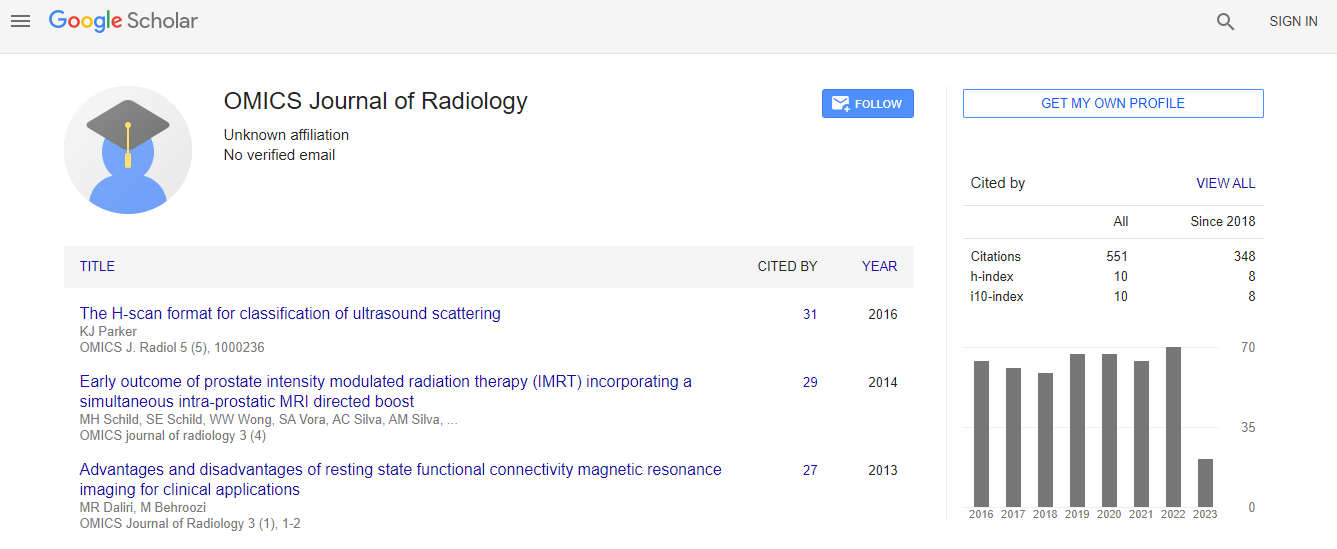
Citations : 551
Indexed In
- Index Copernicus
- Google Scholar
- Open J Gate
- Genamics JournalSeek
- ResearchBible
- Electronic Journals Library
- RefSeek
- Hamdard University
- EBSCO A-Z
- OCLC- WorldCat
- SWB online catalog
- Virtual Library of Biology (vifabio)
- Publons
- Geneva Foundation for Medical Education and Research
- ICMJE
Useful Links
Share This Page
Prevalence of hepatic fibrosis using shear wave elastography among Filipino patients sonographically assessed with fatty liver disease
2nd World Congress on Radiology and Oncology
Jonathan Agustin R Castro
Cardinal Santos Medical Center, Philippines
Posters & Accepted Abstracts: 中国P站 J Radiol
DOI:
Abstract
Background: Fatty liver disease is the most common finding in abdominal ultrasound examinations, wherein a relevant percentage may develop liver cirrhosis. This study reveals the prevalence of hepatic fibrosis on patients who with fatty liver disease and takes into account the association of both factors. Aim & Method: All shear wave ultrasound results from February 1, 2016 to January 31, 2018 were reviewed. The total patients with and without fatty liver disease and hepatic fibrosis were tabulated. Mean shear wave values were recorded and classified according to the degree of fibrosis. Result: Of the 208 patients having fatty liver disease, a total of 142 (68.3%) patients had evidence of fibrosis. Only 66 (31.7%) patients had normal results. 126 (88.7%) of the patients with fibrosis had were classified mild, 12 (9.2%) of them were moderate and 3 (2.1) were severe. 23 (16.2%) were within 20-39 years, 67 (47.2%) were between 40-59 years, 47 (33.10%) between 60-79 years and 5 (3.5%) were >80 years. 77 patients (54.2%) were male and 65 (45.8%) were female. Age and gender were tested for correlation to hepatic fibrosis using a CI=95% which revealed a p-value of <0.98 for age and <0.93 for gender; both were not significant. The prevalence of fibrosis in patients with hepatic steatosis was tested for significance with a CI=95% revealing a p-value of <0.0001, which was significant. Association between steatosis and fibrosis was also tested using a CI=95% showing a p-value of <0.0001, which was significant. Conclusion: This study reveals that the prevalence of hepatic fibrosis on patients with fatty liver disease is statistically significant. A significant association between fatty liver disease and hepatic fibrosis has been proven in this study. There is however, no gender or age range predisposition for hepatic fibrosis.Biography
E-mail: tamcastro88@gmail.com
